
Setting Up Cane Drone Reeds
Cane drone reeds are easy... give them a try.
As with any reed, you should take care when handling in order to avoid damage or disturbance of the tongue.
Seating your Reeds
Insert the reed into the reed seat of the drone. Many pipes will have had the reeds seat reamed out to accommodate some types of synthetic drone reeds, it is very important that enough waxed hemp is used to fill in this wider seat and form a good seal as shown.
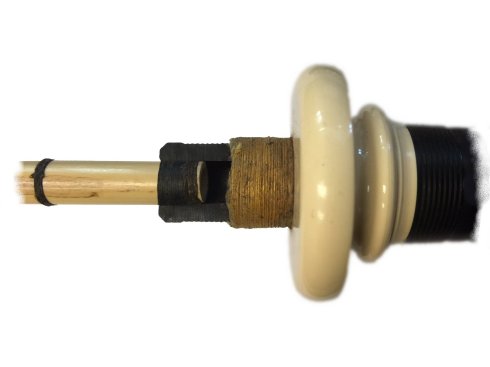
Ensure a good seal between reed seat and reed. We would recommend that you use hemp coated with cobblers wax or thermo-wax. This wax will stick to the wood and prevent movement, beeswax hemp and pre-waxed hemp has a tendency to slip.
Getting Cane Reeds to Vibrate
It will now be necessary to set your reeds to take the correct amount of air for your bagpipe and strength of chanter reed. You may find at first that the reed will emit only a slight sound, or perhaps no sound at all, this is quite normal with cane drone reeds as the tongue can close after leaving the workbench. If this has happened, there can be a number of ways in which to re-spring the tongue. As with many things, there is no right or wrong method. We would recommend that you experiment a little and find out what works for you. Usually a combination of methods will provide you with the desired results.
Springing the Tongue
1) Gently spring the tongue by lifting the end of it a few times by 5 to 6 mm, do not let the tongue snapback on the reed as this will eventually damage the fibres.
Rolling the Reed
2) Gently roll the reed between the palms of your hand.
The Hair Method (Recommended)
3) Insert a hair under the tongue and slide the hair carefully right up to the bridle. If this results in the reed now taking too much air just move the bridle down a fraction towards the waxed end of the reed. Some times, it may be necessary to use two or three hairs to obtain the required lift in the tongue.
The Paper Clip Method
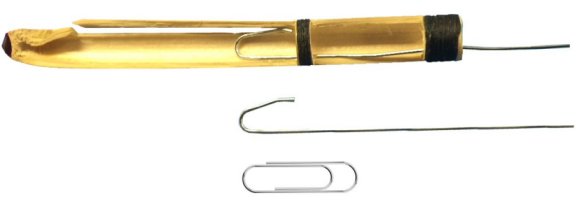
4) Unfold a paper clip as shown and insert it into the open end of the reed. Position it so that the raised end gently pushes on the tongue at a point close to the bridle. Moving the clip in will lift the tongue to take more air, moving it out will reduce the opening and the amount of air.
Heat Set
5) Heat set the Tongue. Carefully slide a thin blade or thin piece of card under the tip of the tongue and gently apply heat from a lighter or match just in front of the bridle. A couple of seconds is long enough. Be careful though as too much heat applied to the reed will scorch and ruin it.
The preferred method by far is number 3, the hair. You will have a much steadier reed for a far longer period of time using this method.
Setting the pitch
Methods for Sharpening the Pitch
Now that the reed is vibrating you can set the pitch, again you will achieve this by a combination of methods. You can sharpen it by positioning the reed further into the drone. Additionally moving the bridle away from the drone towards the waxed end of the reed will also sharpen the pitch. If additional pitch increase is required then you can shorten the over all length of the reed. First, remove the hemp from the open end, then with a small saw or sharp knife cut about off about 2-3 mm. This can be repeated but be careful not to shorten the reed by more than about 8 mm. After shortening the body rough up the last 6 mm of the open end with sand paper, just enough to remove the shine, then re-apply the waxed hemp. Should you require further pitch increase you can obtain this by packing the nose of the reed with some putty or similar non-toxic pliable plastic
Methods for Flattening the Pitch
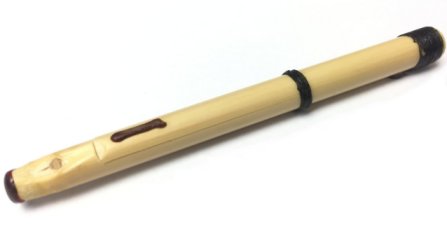
You can achieve this by positioning the reed further out of the drone. If further decrease in pitch is required, then moving the bridle towards drone away from the waxed end will flatten the reed. Should you wish to lower the pitch further you can add some weight to the tongue. This can be done by gently dripping a drop of sealing wax near the end of the tongue as shown below, alternatively add a couple of thin strips of black tape. It takes very little weight to flatten off a reed.
Adjusting the Bridles
The bridle is one of the keys to success with cane. Some people will be satisfied with the use of elastics as bridles but you will have to be a lot more selective with your reeds if using these. By far the most versatile bridle is the simple waxed hemp one. The secret of success with a waxed hemp bridle is that of tension. Know how to tie the bridle correctly and you will soon get a feel for required tension. As with the reed seat, use cobblers wax or thermowax for this purpose. Apply the cobblers wax to ensure that the hemp will resist moisture. As you are pulling the strands neatly together, pull the free end to tension the bridle. After tying the bridle test the reed, if the reed squeals or stops then the bridle may be too tight. If the reed is unsteady or dull sounding then the bridle maybe too slack.
Learn how to apply cobbler's wax to unwaxed yellow hemp string to create a secure, non-slip foundation on your bagpipe drone reed seats and bridles.
A step-by-step tutorial on how to tie a traditional hemp bridle onto a cane drone reed tongue to accurately regulate air flow, control air usage, and adjust pitch.
Understanding Your Reeds and Bagpipe
Cane drone reeds enjoy a certain amount of moisture, as do chanter reeds, if you use a moisture control system you should be adjust it to allow for this. Please remember that, as with chanter reeds, cane drone reeds will go through a blowing in period before they operate at their full potential. By the time you have blown in your reeds you will have developed a feel for them and will know the “steady window” for your bagpipe. This period will depend on various factors such as moisture control, how selective you have been with your reeds and general climatic conditions.
Drone valves, or tone enhancers, are not necessary with cane drone reeds.
Over time you will learn what size of reed suits your set up and pipe best, things to take note of are diameter, wall thickness, tongue weight and width. There is no right or wrong as every pipe and importantly every player is different. Remember it is not that pipe that makes the player it’s the player that makes the pipe, it’s what an individual does to a bagpipe that makes the difference.
Cane Manipulation Videos
The follow videos were made as instructional videos for members of the Inveraray and District Pipe Band. They were not intended for the general public so I apologise if I am a little unshaven and casual. I will add to them as time allows.
Learn how to gently roll a new cane drone reed tongue to open up the gap, break in the fibers, and get a stiff or quiet reed to vibrate freely.
Discover the correct way to insert, remove, and handle delicate cane drone reeds safely without cracking the tongue or breaking the body of the reed.
See how to safely place a hair under a cane reed tongue to restore its vibration, increase airflow, and prevent the reed from shutting down.
Cane Drone Reeds Part 1
Cane Drone Reeds Part 2
Cane Drone Reeds Part 3
Cane Drone Reeds Part 4
Cane Drone Reeds Part 5
Cane Drone Reeds Part 6
Cane Drone Reeds Part 7